How to Select the Best Custom Software Developers in Austral
A practical guide to choosing custom software development partners in Australia, covering process, costs, IP ownership and what actually separates good developers from average ones.
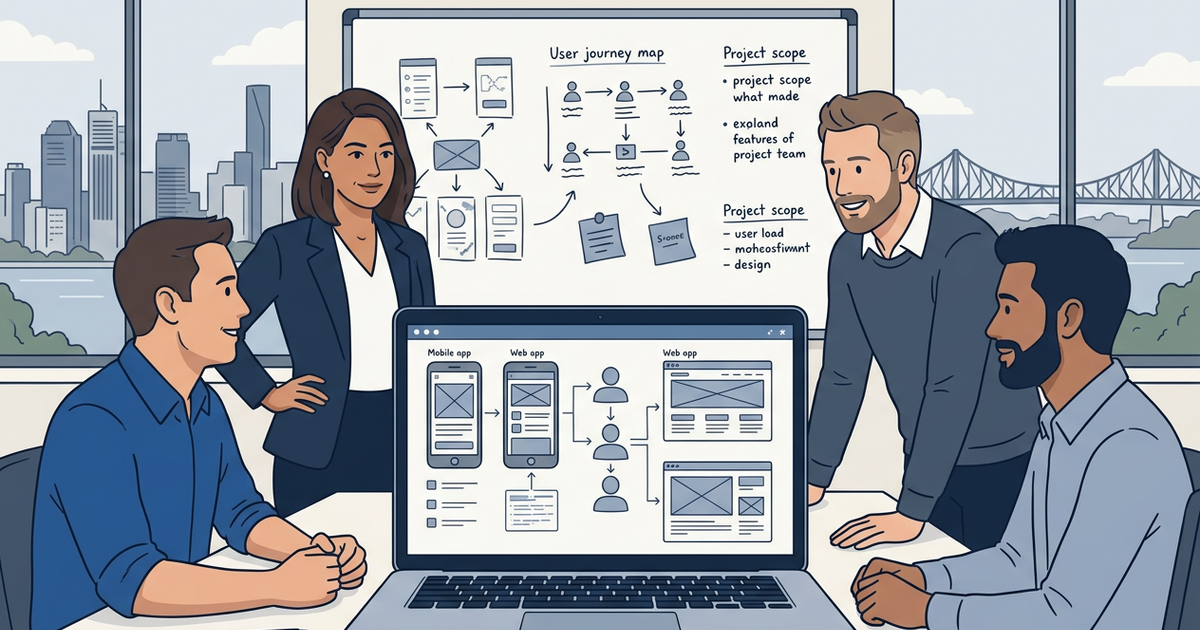
Most small businesses don't wake up wanting custom software. They wake up with a problem — a spreadsheet that's fallen over, a booking system that doesn't talk to their accounting software, a manual process eating twenty hours a week — and someone eventually says "we should just build our own thing." That's usually the right instinct. The hard part is knowing who to trust with it.
This guide walks through what custom software development actually is, when it beats buying off-the-shelf, and — most importantly — how to pick a development partner in Australia who won't leave you locked into their support contract for the next decade.
What is custom software development?
Custom software development is the process of designing and building an application from scratch to fit one specific business's workflows, rather than adapting that business to fit a pre-built product. Off-the-shelf software (think Xero or Salesforce) is built once and sold to thousands of businesses; SaaS is that same software delivered as a subscription; low-code platforms sit in between, letting you assemble an app from templates with limited custom logic. Custom software is the only option built entirely around how your business actually works — and it's the only one where you own the code, the data and the intellectual property outright.
Why custom software development matters for small businesses right now
The Australian software development market was valued at USD 3.86 billion in 2025 and is projected to reach USD 17.33 billion by 2034, growing at close to 18% a year. Small and medium businesses already make up the largest share of that demand — not enterprise, not government. That's worth sitting with for a second. This isn't a big-corporate trend trickling down. SMEs are the ones driving it, largely because the same off-the-shelf tools that got a business to a certain size stop bending once operations get more complex.
The same research also found that in-house, owned codebases lead market demand over subscription-style tools, which tells you something about what businesses actually want once they've been burned by licensing fees a few times: ownership, not access.
Custom software vs off-the-shelf: how to actually decide
| Criteria | Off-the-shelf / SaaS | Custom software |
|---|---|---|
| Fit to your workflow | You adapt to it | It's built around you |
| Ongoing cost | Per-user licensing fees, forever | One build cost, then support only |
| Ownership | You own nothing — you're renting | You own the code, data and IP |
| Integration with existing tools | Limited to what's offered | Built to connect via API |
| Scalability | Capped by the vendor's roadmap | Grows however your business grows |
| Best for | Standard processes, fast start | Unique workflows, long-term plans |
If a spreadsheet, a $30/month app or a template builder solves the actual problem, use that. Custom software earns its cost when your workflow is genuinely unusual, when you're paying growing per-seat fees for a tool that only does 60% of what you need, or when data needs to move between systems that were never designed to talk to each other.
The typical custom software development process
Good developers don't jump straight to writing code — and if a company quotes you a fixed price in the first phone call, that's worth noticing.
- Discovery — mapping the actual business problem, current workflows, and what "done" looks like. This is where a discovery call earns its keep, because it's far cheaper to change your mind here than three months into a build.
- Design — wireframes and UX planning, so everyone agrees on what's being built before anyone writes a line of code.
- Agile, iterative build — working in short cycles, with something reviewable every couple of weeks, not a single reveal at the end.
- Testing (QA) — functional testing, security checks, and real-user testing against the workflows mapped in discovery.
- Deployment — releasing to production, usually in stages rather than all at once.
- Ongoing support — monitoring, hosting, security patching and feature refinement, because software isn't a one-off purchase, it's a living system.
A useful mental model here is the 40/20/40 rule: roughly 40% of effort on planning and design, 20% on actual development, and 40% on testing and refinement. If a provider's plan is almost entirely "build," that ratio is backwards.
What to look for in a team
A proper build needs more than someone who can code. Look for a mix of developers, a solution architect who thinks about how the system scales, a project manager keeping things honest, someone across UX, and dedicated QA. If one person is wearing all five hats, ask how that scales past month three.
Being Australian-based matters more than it sounds. Time zone alignment, plain-English conversations without a translation layer, and accountability that doesn't disappear when the invoice is paid — these aren't small things when you're trusting someone with core business systems.
A quiet advantage worth asking about: has this team actually run a business themselves, or only ever built software for other people's businesses? Developers who've funded and exited their own ventures tend to challenge scope creep and gold-plated features far more honestly than an agency purely billing hours.
Don't skip: IP ownership and no per-user licensing
This is the part most providers gloss over. Ask directly: who owns the code when the project ends? Who owns the data? Are you paying a licence fee per user forever, or did you pay to build something you now own outright? A business that walks away owning its code, data and IP has a genuine asset. A business locked into per-seat licensing has a recurring bill with no equity behind it.
Security, hosting and support after launch
Post-launch is where a lot of relationships quietly fall apart — the build finishes, and suddenly hosting, security patching and support are someone else's problem, or three separate vendors. Ask whether design, build, hosting and support genuinely sit under one roof, because coordinating a security patch across three different companies during an actual incident is not where you want to discover the gaps.
Where AI fits in
AI automation isn't a bolt-on anymore — it's increasingly baked into the custom build itself: automating data entry, flagging anomalies, drafting customer responses, or connecting workflows that used to need a person copying information between two systems. If a developer treats AI as a separate product rather than part of the same conversation about your workflows, that's a sign they're behind the market, not ahead of it.
A note on cost and tax incentives
Custom builds vary too much in scope to quote a single number honestly, but as a rough guide, small business projects typically start in the tens of thousands and scale with complexity. Worth knowing: eligible software R&D work can potentially be claimed under Australia's R&D Tax Incentive, which can offset part of the development cost — it's worth raising with your accountant early, before the project starts, not after.
If you're at the stage of comparing providers, it's worth looking at recent work a team has actually delivered, not just their pitch deck. And if you'd rather talk it through than read another comparison table, get in touch — the first conversation costs nothing and tends to clarify more than another hour of searching will.