AI development & integration
How to deploy AI in your business: a seven-step guide
Deploy AI one narrow task at a time: pick the task, build it into your workflow, keep a person in the loop and check privacy first. Seven steps.
An AI readiness assessment ranks the tasks in your business where AI would pay back. Here is what it covers, how to score a task yourself and what to expect.

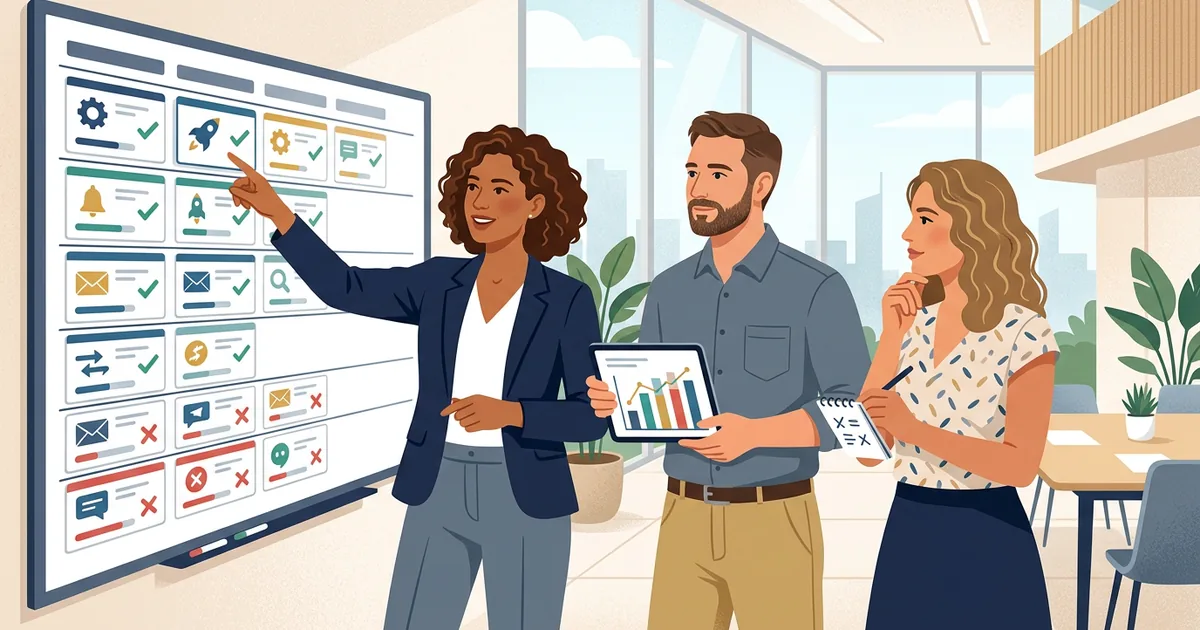
An AI readiness assessment is a short review of where your business spends repeated effort, whether the data and tools around that work are ready, and which one or two tasks AI could take on reliably and pay back. A good one ends with a ranked list, a rough cost and a plain recommendation, including “do not build this” when that is the honest answer.
Most businesses do not need an AI strategy. They need to know which task to automate first, what it will cost to build and run, and whether the result can be trusted. This guide shows what an assessment covers, how to score a task yourself in about ten minutes, and what a good one should hand you at the end.
Five checks decide whether a task is ready for AI. Each one is a question about the work, not about the technology.
Write down the task, then score it against this table. Two or more warning signs means the task is not ready, or not worth it.
| Check | Good sign | Warning sign |
|---|---|---|
| Frequency | Happens daily or weekly | Happens a few times a year |
| Hours | Several hours a month or more | A few minutes a month |
| Output | A person or rule can check it quickly | Nobody can tell if it is right |
| Data | Inputs are in email, documents or a system | Inputs live on paper or in someone’s head |
| Mistake cost | A wrong output is caught and fixed cheaply | A wrong output reaches a customer or a regulator |
This is an illustration, not a quote. Suppose a team spends 20 hours a month sorting and replying to routine enquiries, and an hour of that time costs the business $60. That is $1,200 a month, or $14,400 a year. A small build runs roughly $5k to $10k plus running costs, so payback inside the first year is plausible. If the same task took two hours a month, it would not be. The numbers decide, not the enthusiasm.
Many tasks need a rule or a script, not AI. A good assessment checks that before recommending a model.
| Rule or script | Smaller model | Large language model | |
|---|---|---|---|
| Best for | Fixed logic with clear conditions | Classifying and extracting from text | Drafting, summarising and answering questions |
| Running cost | Negligible | Low | Highest per use |
| Example | Send invoices over a set amount to approval | Tag incoming emails by topic | Draft a reply from a customer’s history |
| Checking the output | Predictable | Spot checks and thresholds | A person or a rule reviews it first |
Trust is the biggest reason many Australian businesses give for holding back. The National AI Centre’s AI Adoption Tracker, which surveys about 400 small and medium businesses each month, put SME adoption at 44% in February 2026. Its December 2025 to February 2026 overview says more than half of Australian SMEs have yet to adopt AI in a meaningful way, and that trust was the single biggest reason given.
An assessment answers that directly. It names what the AI will do, who checks it, what it costs to run and what happens when it is wrong. Trust follows from checks that are written down.
You should leave with something you can act on, in writing:
If you leave with a slide deck of buzzwords and no numbers, you have bought a presentation, not an assessment.
Our assessment is free: a 30-minute call with a senior developer and a short written summary. Builds that follow typically land between $5k and $100k+, depending on size, complexity and deliverables. A first, narrow feature is usually a small build at roughly $5k to $10k, quoted at a fixed price before we start. Larger work begins with a fixed-price Discovery, which is credited against the build if you build with us. Full ranges are on the AI assessment and deployment page.
The assessment suits small and mid-sized Australian businesses with a repeatable process that takes staff time: admin, enquiries, quoting, document handling or reporting. It does not suit businesses after an AI strategy deck, a chatbot for its own sake or a general training session on ChatGPT. If you want to see how it works end to end, start with the free AI assessment, or read the companion guide on how to deploy AI in your business.
A short review of where your business spends repeated effort, whether the data and tools around that work are ready, and which tasks AI could take on reliably. It should end with a ranked list, a rough cost and a recommendation.
Scoring a single task yourself takes about ten minutes. Our free assessment is a 30-minute call with a senior developer, followed by a short written summary.
No. You need the inputs for one task to be reachable and good enough to act on, not a clean company-wide data warehouse. The assessment checks that for the specific task.
Yes. It is a 30-minute call and a short written summary, with no obligation to build anything. If there is a task worth doing, we give you a rough cost to build and run it.
Want a fixed price for your project?Start with a fixed-price Discovery: a written scope and a firm quote before you commit to a build.
Book a discovery call →Deploy AI one narrow task at a time: pick the task, build it into your workflow, keep a person in the loop and check privacy first. Seven steps.
A software Discovery turns a rough idea into a written scope, a prototype and a fixed quote. Here is what happens, what it costs and what you get.
Bespoke or off-the-shelf software? Here is how to decide, what each costs over time, and when a mix of both is the better answer.